 English


Abstract: The BPC-157 peptide has a broad spectrum of activity, directly improving the functioning of many organs and systems. Its function of protecting against microorganisms allows the immune system to be maintained in proper condition, which prevents the development of infections with pathogens and leads to their faster elimination from the body.
Keywords: immune system; BPC-157 therapy; spleen; lymph nodes; tonsils; herpes virus
List of abbreviations: BPC-157 – Body Protection Compound; HSV-1 – Herpes Simplex Virus; LPS – Lipopolysaccharid
Immune system
The immune system, also known as the immunological system, provides protective immune mechanisms thanks to its constituent organs. It is the first line of defence against various types of microorganisms, and thanks to its activity, not every contact with microbes results in an infection that is dangerous to us. In addition, the immune system is able to distinguish between its own cells and foreign cells and acquire immunological memory by remembering the antigens it has encountered, enabling it to act more quickly and effectively in times of danger.
Structure and functions of the immune system
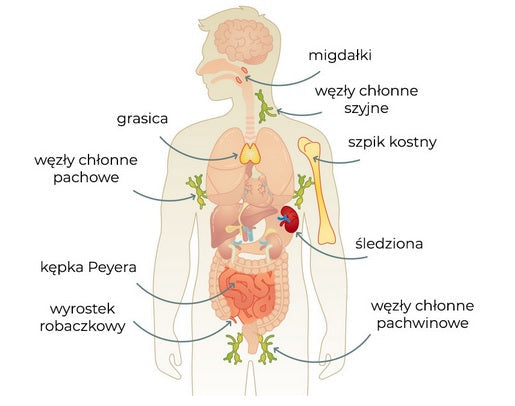
The human immune system consists of many organs that are functionally interconnected. The immune system includes primary and secondary lymphatic organs. The former are responsible for the development of lymphocytes, i.e. their maturation and transformation into functionally active cells, while the latter enable these cells to function properly. The largest organ of the immune system is the spleen, whose main function is to produce antibodies, lymphocytes and monocytes. Other functions of the spleen include blood storage and participation in the removal of abnormal blood cells. It is worth mentioning that it is possible to function without a spleen, but this is associated with a significant weakening of the immune system. Another element of the immune system are the lymph nodes, which are responsible for filtering lymph. The tonsils, which are organs of the immune system, allow the immune system cells to multiply, thus protecting against microorganisms from the air or food. Immune system cells include lymphocytes, macrophages, phagocytes, granulocytes, antibodies and NK cells. The diagram below provides a visual overview of the structure of the immune system. (Fig. 1)

Figure 1. Structure of the immune system
The effect of BPC-157 therapy on the immune system
The BPC-157 peptide is recognised as a peptide with antimicrobial activity against Gram-positive and Gram-negative bacteria, fungi and enveloped viruses. BPC-157 is an important component of the anti-infective defence system. Its mechanism of action is based on binding LPS, IL-1β and TNF-α, which are components of the cell wall of Gram-negative bacteria, leading to their release from the bacterial wall, destruction of the cell wall and death and destruction of the microbial cell. This action additionally causes this mechanism to function as the first line of defence against pathogens.
BPC-157 therapy in the treatment of herpes virus
BPC-157 peptide therapy for the common herpes virus is associated with its direct effect on virus particles and their inactivation, most often affecting enveloped viruses, in which the envelope, necessary for the fusion of the virus with the host cell, disintegrates. The mechanism of action promoting the treatment of herpes with BPC-157 peptide involves neutralising the herpes virus (HSV-1) and reducing the risk of its occurrence with systematic and long-term use, preventing the virus from entering the cell.

Figure 2. Effect of BPC-157 therapy on the herpes virus
Summary
Proper functioning of the immune system is essential for comfort of life. BPC-157 in the form of intragastric administration (via capsules or by dissolving the substance in water) has a beneficial effect on our immune system. It is safe to say that BPC-157 in the form of a stable salt is a new precursor in the treatment of immune system disorders.
Bibliography
- M.Knezevic, Gojkovic.S, Krezic.I, Zizek.H, Knezevic.T, Occluded Superior Mesenteric Artery and Vein. Therapy with the Stable Gastric Pentadecapeptide BPC 157. Biomedicines 2021; 9(7), 792; DOI:10.3390/biomedicines9070792 https://doi.org/10.3390/biomedicines9070792
- Seiwerth.S, Milavic.M, Vukojevic.J, Stable Gastric Pentadecapeptide BPC 157 and Wound Healing. 2021 Jun 29;12:627533; DOI:10.3389/fphar.2021.62753310.3389/fphar.2021.627533
- Gojkovic.S, Krezic.I, Vranes.H, Zizek.H, Drmic.D, BPC 157 Therapy and the Permanent Occlusion of the Superior Sagittal Sinus in Rat: Vascular Recruitment. Biomedicines 2021 28;9(7):744. doi: 10.3390/biomedicines907074410.3390/biomedicines9070744


BPC-157 peptide therapy in supporting sports injuries in athletes and physically active individuals
Characteristics of peptides. Peptide synthesis and modifications