 English


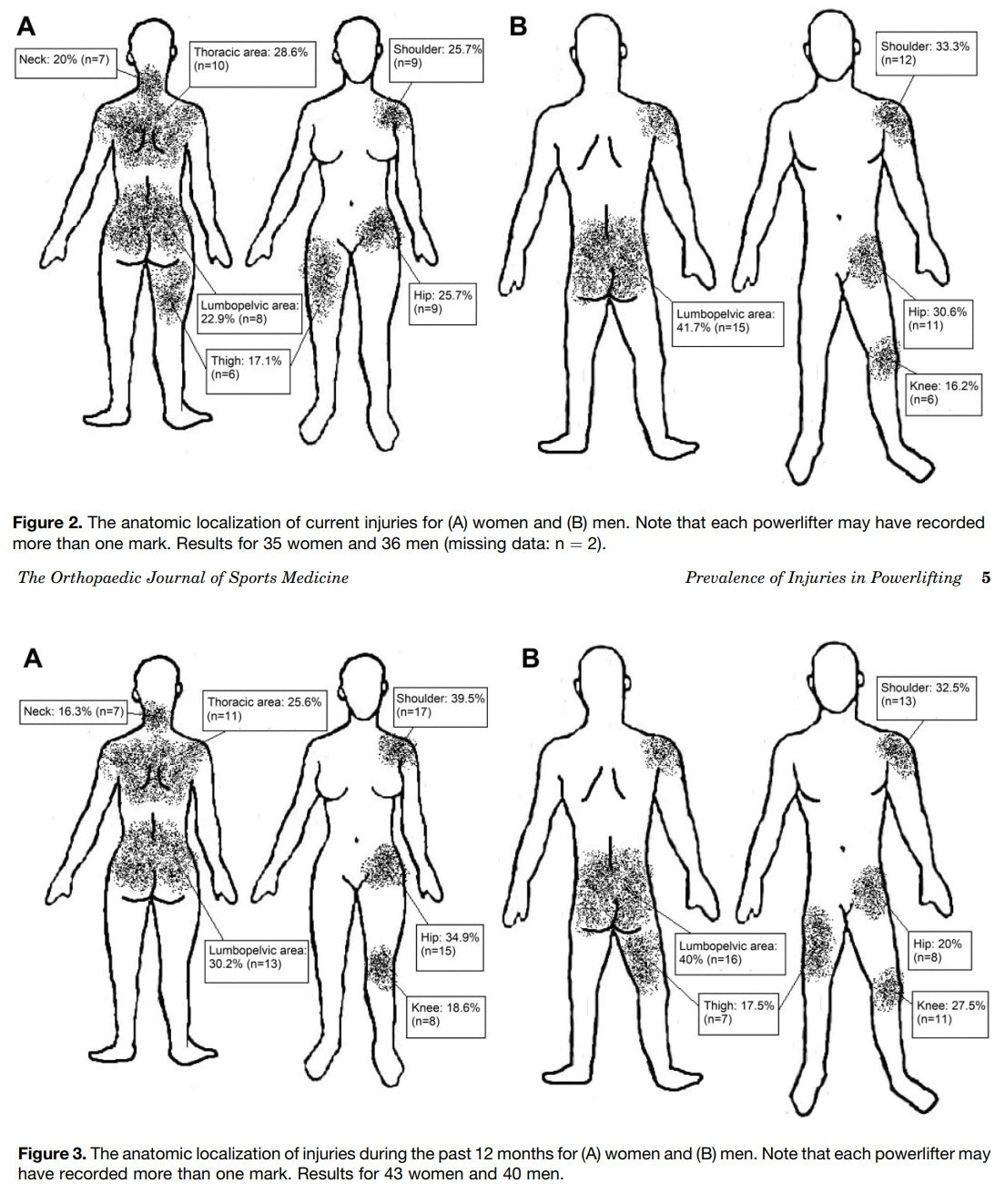
The injury rate in powerlifting appears to be relatively low, ranging from 1.0 to 4.4 per 1000 hours of training. For the purposes of this article, an injury is defined as a state of pain or impaired bodily function that affects powerlifting training. There is evidence that disordered eating behaviors as well as excessive alcohol consumption (5 standard drinks per week) are associated with musculoskeletal injuries. These individuals do not achieve optimal recovery after training, which is linked to a higher susceptibility to injuries.
Injury-causing factors in powerlifting
Injury-causing behaviors in powerlifting include the lack of optimal training progression. We must understand that ligaments and the nervous system take longer to recover than muscles, so testing maximum lifts every training session is not optimal for recovery and may lead to dangerous injuries. Both the lack of optimal technique (okay, let’s agree that for everyone it will be individual; we do not aim for “textbook ideals” because they do not exist) contributes to overloads, which in turn lead to injuries. Reduced adaptation to high or maximal loads during competitions may contribute to a greater risk of injury. It is known that training before competitions should become increasingly specific, as different training methods cause different physiological adaptations. Load or training intensity is one of the main factors affecting not only the power and movement mechanics of the trained motion but also neuromuscular structural adaptations. Therefore, selecting appropriate training loads and repetition ranges can reduce injury risk by improving adaptation.
Prevention in the squat
One study examined three categories of biomechanical effects in the squat, primarily:
(A) tibiofemoral compression and shear forces and patellofemoral compression,
(B) activity of the quadriceps and hamstring muscles, and
(C) anterior-posterior and medial-lateral knee stability.
Regarding compressive and shear forces, they showed these increase with greater knee flexion. Attention is also important on the pressure on structures in and around the knee joint during squatting with simultaneous knee flexion, hip adduction, and internal rotation of the thigh bone (valgus stress). The deeper the squat, the greater the load on the hip and knee joints, assuming the same weight is used. As for foot placement, too wide a stance may increase tibiofemoral compressive forces on the kneecap, while a narrow stance increases anterior shear forces. A higher speed of descent (we are talking about a “bomb” style squat) increases anterior-posterior shear and compressive forces in the knee joint. Additionally, it was shown that a bouncing movement at the bottom of the squat increases shear forces in the knee joint. It is said that a fast and uncontrolled descent causes excessive deformation and shear forces on the cruciate and collateral ligaments, which could damage these structures. Uncontrolled descent also affects spinal posture—a greater forward lean was shown during repeated squats (>10 repetitions) at high speed. And a greater forward lean was associated with increased shear forces in the lumbar spine. A high bar position shifts part of the load from the hips to the knees. Many injuries occur during squats, such as knee pain, which may be caused, for example, by insufficient kneecap stabilization; strengthening the vastus medialis obliquus (VMO) can help here. Improper foot function can functionally shorten the first ray (big toe to heel and rotate everything outward), which affects the entire squat biomechanics and may cause many injuries. Also, excessive “gripping the ground with the toes” during lifts can lead to hypertrophy of the flexor muscle group, which also disrupts proper foot function, which should be a stable base where the entire kinetic chain begins or ends during lifts. Frequent strains and pulls of muscles in the groin area may be caused by improper gluteal muscle function, overloading, for example, the adductors, which take over hip extension work (here you can often see “knees coming together inward” during the lift). As for the common cause of elbow pain during squats, I would look for improper scapular mechanics or imbalances between the forearm extensor and flexor groups. However, of course, I simplify these examples, as there can be many causes; I just want to show you some of them.
Prevention in the bench press
Studies on the bench press have shown that using a wide grip places the shoulder joint in an unfavorable position, loading the acromioclavicular joint, coracohumeral ligaments, and the pectoralis major muscle. Additionally, provided the shoulder abduction/extension angle remains the same, a wider grip increases the shoulder’s torque, which increases the demands on the rotator cuff muscles and the biceps tendon, which stabilize the head of the upper arm bone. The most common injuries during the bench press are shoulder dislocations, tears of the pectoralis major muscle (most often in men), overloads and strains of the rotator cuff ligaments and muscles, and tendon inflammation. The causes I would look for include improper scapular mechanics and failure to perform anterior depression during lifts. Additionally, lack of engagement of the latissimus dorsi muscle and overreliance on the pectoralis major leads to its overload and resulting injuries. Lack of scapular stabilization leads to overload of the rotator cuff and muscles stabilizing the shoulder joint, resulting in dislocations, instability of the upper arm bone, or tendon injuries around the joint. Improper technique is also associated with overloads in the lumbar spine, because excessive arching in the lumbar spine instead of the thoracic spine (where we often have mobility limitations and excessive kyphosis or flattening) causes compensation and excessive overload. Proper technique allows longer enjoyment of training without injuries in the shoulder girdle area.
Prevention in the deadlift
It is believed that maintaining lumbar lordosis during the deadlift reduces injury risk. It is also important to keep the bar close to the body to improve efficiency and reduce injury risk due to a more economical bar path along the body and proper scapular function along with latissimus dorsi activity. Regarding the knees, it is said that it is important not to extend the knees prematurely or excessively to avoid what is called the stiff-legged deadlift, which occurs when the knees are near or fully extended. This reduces quadriceps activity and increases activity of the spinal erectors but, perhaps more importantly, results in a less extended torso position. It seems this does not affect compressive forces on the L4/L5 disc but reduces the moment at L4/L5 and shear forces compared to a more bent-over posture. Performing deadlifts (especially with improper technique) more than once a week may lead to overload of ligaments near the sacroiliac joint and subsequent injuries. A common sight at competitions regarding injuries during deadlifts is biceps tears with a mixed grip (so-called alternate grip), most often caused by lack of full elbow extension and shortened biceps brachii muscle, because a muscle that cannot work through its full physiological range is weakened.
Pelvic floor muscles (PFM)
I would not be myself if I did not mention the pelvic floor muscles (PFM) in this article. Although not necessarily anyone would call it an injury, I am talking here about stress urinary incontinence, which is a very important issue I want to bring closer to normalize this topic as much as possible. There are various causes of this phenomenon; according to studies, it occurs more often among female powerlifters due to overly tight PFM rather than weakness, because strength training with proper progression should strengthen them. However, a constantly tight muscle will be weak—imagine holding a clenched fist; after 5 minutes it’s okay, after an hour it starts to hurt, and after a longer time you have no strength to keep it clenched—PFM behave the same way if we do not care for their relaxation; they will function like the fist I described earlier. I want to point out, without going into details, that stress urinary incontinence happens in this sport and there is no shame in it; one should seek help from a urogynecological physiotherapist. Of course, this can also happen to men, more often as rectal prolapse, but among women, this dysfunction occurs much more frequently.
Conclusion
So what should prevention look like to minimize injury risk in powerlifting? Powerlifters should definitely start paying more attention to cardiovascular work, which positively affects the circulatory system including our heart and improves recovery capabilities. Of course, at first, I would recommend increasing the amount of walking and gradually increasing the intensity of aerobic exercises as possible. Additionally, do not undervalue GPP, that is, additional training with movements not specific to powerlifting, because it is worth moving in other planes than just the static three lifts. Studies indicate that regular sauna use is correlated with a lower injury rate, confirming its regenerative effect on the musculoskeletal system through presumed mechanisms of increased blood flow in the skin and muscles, faster breakdown of metabolic products, and regulation of many genes specific to muscle growth and atrophy (9). Swimming as a leisure activity was correlated with fewer injuries (p = 0.027, r = -0.288). Additionally, I remind you that 7-8 hours of sleep also positively affects better recovery and well-being; it would be good to limit blue light exposure at least half an hour before bedtime (apps with filters on phone/laptop or special glasses, or just take a book and read for that half hour :) ). Studies show that older athletes (>30 years) suffered significantly fewer injuries (p = 0.004; r = -0.373) than younger athletes. This may indicate greater training and competition experience; I also believe that more experienced individuals use coaches who design tailored periodization instead of testing max lifts every week in training, as younger people starting their powerlifting journey tend to do.
BPC-157 in powerlifting
Regarding nutrition, powerlifters are not the best example; they often do not pay attention to the nutritional value of their meals, additionally they do not limit alcohol much, and in many cases, overweight occurs. If we add doping substances to all this, our liver and internal organs may not cope well with inflammation. The peptide BPC-157 may help regenerate the digestive system, with a very low frequency of side effects. Among those using BPC-157, very good effects are reported in alleviating various symptoms related to stomach or intestinal function. If we fail to avoid injuries, studies on BPC-157 have consistently shown positive and rapid healing effects in various types of injuries, both traumatic and systemic, and in many soft tissues. It is a therapy for healing and restoring functional capacity of soft tissue damage, with emphasis on healing of tendons, ligaments, and skeletal muscles. Among the regenerative mechanisms of BPC-157 is the ability to accelerate fibroblast growth, resulting from increased expression and activation of FAK and paxillin proteins. Another healing mechanism is stimulating a process called angiogenesis (formation of new blood vessels).
References:
1. “Prevalence and Consequences of Injuries in Powerlifting: A Cross-sectional Study” Edit Strömbäck,* Ulrika Aasa, Kajsa Gilenstam and Lars Berglund, Investigation performed at Umeå University, Umeå, Sweden
2. “Injuries and Overuse Syndromes in Powerlifting” J. Siewe, J. Rudat, M. Röllinghoff, U. J. Schlegel, P. Eysel, J. W.-P. Michael
3. “Narrative review of injuries in powerlifting with special reference to their association to the squat, bench press and deadlift” Victor Bengtsson, Lars Berglund, Ulrika Aasa
4. “Injuries among weightlifters and powerlifters: a systematic review” Ulrika Aasa, Ivar Svartholm, Fredrik Andersson, Lars Berglund
5. “Incidence and characteristics of acute and overuse injuries in elite powerlifters” Thomas Reichel, Martin Mitnacht, Annabel Fenwick, Rainer Meffert, Olaf Hoos & Kai Fehske
6. “Modulation of early functional recovery of Achilles tendon to bone unit after transection by BPC 157 and methylprednisolone” A. Krivic, M. Majerovic, I. Jelic, S. Seiwerth, P. Sikiric
7. “Gastric pentadecapeptide body protection compound BPC 157 and its role in accelerating musculoskeletal soft tissue healing” Daniel Gwyer, Nicholas M. Wragg, Samantha L. Wilson
8. “The promoting effect of pentadecapeptide BPC 157 on tendon healing involves tendon outgrowth, cell survival, and cell migration” Chung-Hsun Chang, Wen-Chung Tsai, Miao-Sui Lin, Ya-Hui Hsu, and Jong-Hwei Su Pang
9. Hannuksela and Ellahham, 2001; Leppäluoto et al., 1986; McGorm, Roberts, Coombes and Peake, 2018

Neuroprotective and antidepressant effects of BPC-157. The impact of BPC-157 on brain function.
BPC-157 in the digestive system. Cytoprotective effect of BPC-157 in disease conditions of the stomach, intestines, and liver.