 English


Peptide therapy with NL-GHK-Cu, as a modern therapy, allows stopping or significantly alleviating the problem of baldness or hair weakening of various origins.
| Abstract: The problem of baldness, excessive hair loss, and significant weakening of hair affects a large number of both women and men. Peptide therapy with NL-GHK-Cu, alongside already available treatments and solutions, belongs to modern methods that allow alleviation of these ailments. Regular use of peptides, as shown in studies, enables significant improvement in the condition and health of our hair. Keywords: •NL-GHK-Cu •hair •hair structure •hair physiology •hair growth •anagen •catagen •telogen •causes of hair loss •role of hair •NL-GHK-Cu peptide therapy |
Introduction
Hair follicles appear already during fetal life. As is known, they begin to work intensively almost immediately, fully covering the scalp within a few months. Excessive hair loss or baldness is a serious problem affecting men and women of various ages, and its severity is influenced not only by genetics but also by lifestyle. Hair loss and baldness can appear as early as adolescence but most often affect middle-aged and older people. Modern peptide therapy using NL-GHK-Cu allows for the elimination and alleviation of these ailments.
HAIR STRUCTURE AND PHYSIOLOGY
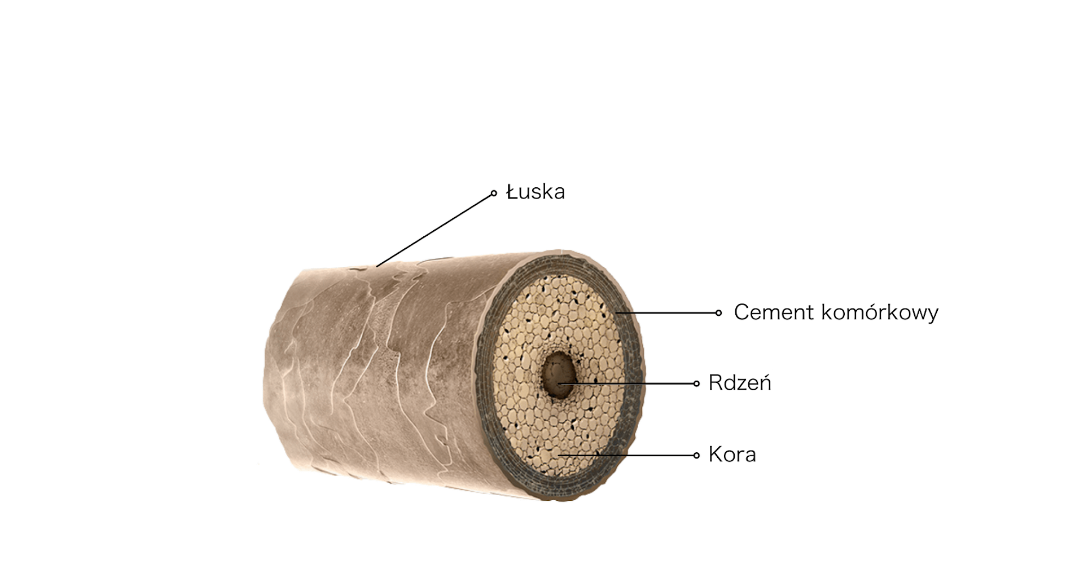
In general reasoning and definition, hair is a filamentous, keratinized, and specialized product of the epidermis. Hair occurs exclusively in mammals, on the surface of their skin. It is mainly composed of protein, more precisely of hard, compact keratin present in the hair in amounts ranging from 65% to 95%. The most important amino acid in the composition of hair keratin is cysteine. Cysteine contains a thiol group in its structure, which allows the formation of disulfide bridges. The quantity and arrangement of disulfide bridges determine the shape of the hair, giving it the form of curls or accounting for its straight character. The hair root positioned in the skin is at an oblique angle. It is connected to the arrector pili muscle, which responds to stimuli such as cold or fear, causing it to contract, which in turn leads to hair standing up. Directly above the muscle are the sebaceous glands. Their ducts enter the hair follicle near the epidermis, between the hair shaft and the follicle wall. The secretion of the sebaceous glands, commonly called sebum, which is delivered through the hair follicle to the surface of the hair and scalp, serves to regulate the water-lipid balance of the skin and hair. Depending on the amount of this secretion, hair becomes oily faster or slower. Sebaceous glands are so-called holocrine glands, which secrete their contents by the disintegration of the cells that form them, in a discontinuous manner. Hair falls out after 2–6 years, and a new hair later grows from the same hair follicle. The average person, having about 100,000 hairs on their head, loses about 300 hairs daily, which is a completely natural phenomenon known as hair renewal.

HAIR GROWTH
A genetically programmed hair follicle has the ability to produce 20-30 hairs during a person's lifetime. Each hair grows for several years and then falls out so that another can grow in its place. The growth cycle of individual hairs in humans, unlike in animals, is not synchronized, which is why we do not experience molting.
The hair growth process consists of three basic phases, which include:
- Anagen, as the hair growth phase. This phase lasts from 3 to 6 years. In women, this phase is usually longer than in men, which is why they can generally grow longer hair. Conversely, in the case of eyebrows and eyelashes, where the anagen phase lasts only 1 to 2 months, they never grow long.
- Catagen, the transitional phase, is very short and usually lasts from 1 to 2 weeks. During this time, the follicle shrinks, and the papilla decreases in size.
- Telogen, as the hair resting phase. This phase usually lasts from 2 to 4 months. During this phase, the hair completely separates from the papilla and falls out, being "pushed out" by the newly growing anagen hair in the follicle. Telogen hairs are dead (including the root), metabolically inactive, and insensitive to any toxic factors. The hair growth cycle is subject to a complex control system. It can be inhibited or disturbed at any of its phases by many different occurring factors.
Additionally, the hair is supplied with substances necessary for growth by a system of capillary blood vessels that nourish the hair bulb. This is practically the only route of nourishment for the hair, as the skin and the walls of the hair follicle are impermeable to most chemical compounds. The rate of hair growth and its condition largely depend on the functioning of blood vessels that deliver nutrients; therefore, many agents that accelerate hair growth work indirectly, among other things, by improving scalp blood circulation.

ROLE AND SIGNIFICANCE OF HAIR
Human hair primarily protects us from sunlight, injuries, cold, and insects. Hair shafts distribute sebum and sweat from apocrine glands, which open into hair follicles. Hair also serves as a subtle sensory organ, e.g., for touch. Undoubtedly, hair plays a decorative and ornamental role for the head. Although the biological significance of hair seems relatively minor, its loss, regardless of gender and age, is associated with great discomfort and constitutes not only a serious aesthetic problem but also a psychological one.
CAUSES OF HAIR LOSS AND WEAKENING
Hair loss can be caused by many different ailments that are not directly related to the hair. The most common bodily ailments causing hair loss and weakening include:
A. Hormonal disorders Hormones are responsible for about 90% of hair loss cases in men and women. In men, testosterone is metabolized in the hair follicle by the enzyme 5α-reductase into its derivative dihydrotestosterone-DHT, which leads to the miniaturization of hair follicles. As a result, the follicle atrophies, causing hair loss. In women, hair thinning and loss occur when, due to hormonal disorders, certain hair follicles exhibit excessive sensitivity to androgens. Hormones also affect hair loss in women who have recently given birth.
B. Chronic systemic diseases e.g. diabetes, liver diseases
C. Autoimmune diseases e.g., Hashimoto's disease, rheumatoid arthritis
D. Infectious diseases e.g., syphilis
E. Diseases accompanied by high fever e.g., flu, pneumonia
F. Mental illnesses e.g., trichotillomania
G. Drug-induced hair loss
Medications that most often cause hair problems include hormonal drugs, anti-atherosclerotic drugs, cardiac drugs, anticoagulants, anti-psoriatic and anti-acne drugs, antifungal drugs, antiviral drugs, anticancer drugs, and antidepressants.
H. Stress
I. Improper hair care
Improper hair care can lead to significant thinning. Among others, aggressive and frequent hairdressing treatments such as perms, dyeing, straightening, or curling.
J. Poisonings
Poisoning of the body with heavy metals, e.g., mercury, thallium (characteristic pigment deposits in hair during the anagen phase), lead can be a cause of hair loss.
K. Diet
A protein-poor diet can result in insufficient nourishment of the hair follicle. When the body lacks iron or zinc, the effect is similar. For this reason, excessive hair loss can be observed in people suffering from bulimia and anorexia.
In every case of excessive hair loss, the absolute foundation is to collect a detailed medical history from the person struggling with hair loss and weakening, i.e., conducting the so-called subjective examination. The basic aspects that play a main role in specific treatment methods are: how long the hair has been falling out or how long thinning has been observed, how many hairs usually fall out per day, whether hair loss also affects siblings, parents, and grandparents, whether anything preceded the onset of hair loss, e.g., illness, surgery, anesthesia, start of pharmacotherapy, stressful situation, pregnancy, etc., whether the patient takes any medications, whether the patient suffers from any diseases, what the patient's diet looks like (vegetarianism, veganism), whether the patient follows any diet and whether they have attempted or are attempting weight loss, whether menstruation (in women) occurs regularly and whether it is heavy, and whether the patient has already undergone any tests, been consulted by other specialists, and whether they have already undertaken any hair loss treatment.
In the case of male alopecia, to make a proper diagnosis and implement appropriate treatment, a carefully taken history, thorough physical examination, and trichoscopy are often sufficient. In women, in all more or less suspicious cases, additional blood diagnostic tests usually need to be performed. Any additional test results can only be interpreted based on the clinical picture (history and physical examination).
THERAPY WITH NL-GHK-CU PEPTIDE IN THE PROBLEM OF EXCESSIVE HAIR LOSS AND WEAKENING
The NL-GHK-Cu peptide, according to studies, is an important element of therapy inhibiting hair loss. In cases of deficiencies of certain factors, changing or intensifying the diet is not a sufficient solution, so appropriate doses of the peptide, taken regularly, allow for the elimination of the hair loss problem and strengthening of its structure, as well as in the prevention of alopecia.
Through conducted studies, it is known that the tripeptide-copper complex affects hair growth through various mechanisms, including stimulation of skin fibroblasts and increased expression of vascular endothelial growth factor. It is also known to reduce the secretion of transforming growth factor-β1 by skin fibroblasts. Furthermore, it decreases the number of apoptotic dermal papilla cells, showing an elevated Bcl-2/Bax ratio and reduced levels of cleaved caspase-3 forms. NL-GHK-Cu can be considered one of the safe and complementary agents in the treatment of alopecia and excessive hair loss.

BIBLIOGRAPHY
1. Lee WJ, Sim HB, Jang YH, Lee SJ, Kim do W, Yim SH. Efficacy of a Complex of 5-Aminolevulinic Acid and Glycyl-Histidyl-Lysine Peptide on Hair Growth. Ann Dermatol. 2016;28(4):438-443. doi:10.5021/ad.2016.28.4.438.
2. Dorin RJ. Prevention of hair aging processes. Chemistry and Business. Cosmetic and Household Chemistry Market 2014, vol. 2: 197.
3. Kozłowska U, Kozłowska A. Pathophysiology of hair growth and loss. Dermatological Review 2001, vol. 88: 19-25.



Regenerative properties of the NL-GHK-Cu peptide concerning the skin. Peptide therapy in the elimination of postoperative and post-acne scars
NL-Epithalon as a peptide that improves and maintains the functioning of the circulatory system