 English


Abstract: BPC-157 therapy in the world of sports and physical activity is used not only for its regenerative function but also for its protective, analgesic, anti-inflammatory, and anti-edema properties. The broad spectrum of therapy applications allows its implementation as a therapeutic, preventive, and supportive treatment for acquired sports injuries or increased physical activity.
Keywords: sports injuries; sports damage; physical activity; musculoskeletal system; micro-injuries; lateral patellar tilt, BPC-157 therapy; ankle joint; patella; anterior cruciate ligament (ACL) injury; medial meniscus injury; patellar ligament overload; joint injuries; Bennett's fracture; Achilles tendon injury; muscle injuries; muscle strain muscle tear; spinal injuries; shoulder joint degeneration; lateral spinal curvature in the lumbar and thoracic regions; chest injury; rib contusion; prevention
List of abbreviations: BPC- body protection compound;
Sports injuries and damage
The risk of sports injuries is an inherent element associated with engaging in any physical activity. Injuries and damage in sports are usually related to excessive strain during physical exertion. Both professional athletes practicing specific sports disciplines and amateurs engaging in sports, especially when they lack sufficient knowledge about the activity, are exposed to injuries. Proper conduct during sports practice is important because effective results can only be achieved through skillfully performed exercises. Unfortunately, avoiding injuries and damage during any sports discipline is rarely encountered. Engaging in physical activity, both intensive movement improvement and increased muscle strength do not occur without side effects, resulting in accelerated tissue wear, especially in professional athletes, where excessive use affects areas where tissues are genetically less valuable and prone to frequently occurring, cumulative micro-injuries. The alarming, increasing number of injuries and damage to the musculoskeletal system in physically active people can lead to serious dysfunctions, which is why appropriate treatment or prevention at the stage of micro-injury formation is so important, as their effects will not disappear without proper management. Additionally, preventive therapy is used for physically inactive people because the human body is subjected throughout life to very varied loads related to the natural need for movement.

Application of BPC-157 peptide therapy in the case of the most common sports injuries.
Knee joint injuries
The knee joint, as the most functionally and mechanically complex joint in the human body, is also the joint most susceptible to micro-injuries that lead to dysfunctions causing movement limitations, pain, and discomfort in the affected person. As a reminder, the knee joint consists of three bones: the femur, tibia, and patella. The muscles surrounding the knee joint include the tensor fasciae latae, sartorius, quadriceps femoris, vastus intermedius, vastus medialis, vastus lateralis, semitendinosus, semimembranosus, biceps femoris, and gracilis. The knee joint is subjected daily to loads, micro-injuries, excessive tension, or stretching of the muscles surrounding this joint. It is important in the treatment and prevention related to the knee joint to restore or maintain stability, which ensures a proper standing position. It is also important to include balance, stabilization exercises, and appropriate substances as preventive measures against injuries in all training and physical activities. One of the substances acting preventively on the ankle joint is BPC-157. Below we present the most common injuries related to knee joint damage and the therapeutic and preventive profile of BPC-157 in these injuries.
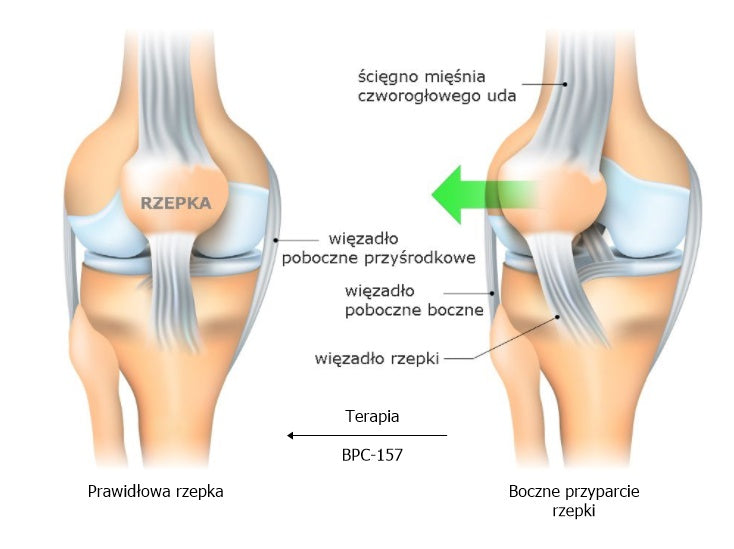
1. Lateral patellar compression
An injury called lateral patellar impingement is associated with trauma occurring in the area of the patellofemoral joint, which is formed by the back part of the patella and the condyles of the femur. The injury results from increased pressure on the lateral condyle of the femur, which disrupts the proper functioning of the patella through its abnormal sliding path. In athletes, where knee bending frequently occurs, this condition leads to limitations in an active physical lifestyle and severe pain. When this injury occurs, it sequentially leads to inflammation, muscle weakening, and damage to the articular cartilage, which if improperly treated, results in serious degenerative dysfunctions. Choosing the appropriate method, symptomatic and preventive treatment leads to the return of physical activity and its maintenance at the previous level.
Therapeutic and preventive action profile of BPC-157 in the case of lateral patellar compression
-
In mild conditions, BPC-157 helps eliminate anatomical disorders, including varus deformity of the ankle joint;
-
In acute conditions, treatment includes rehabilitation supplemented with BPC-157 therapy as an anti-inflammatory and analgesic agent showing anti-receptor activity. Thanks to the peptide's action, pain antagonism occurs, which is based on its effect through the central dopaminergic system. The analgesic effect of BPC-157 is noticeable at a very low dose and in a short time;
In prevention, systematic use of the peptide BPC-157 leads to strengthening of the medial head of the quadriceps muscle and reduction of tension in the iliotibial band of the thigh fascia lata.
2.Anterior cruciate ligament injury-ACL Predispositions related to the occurrence of anterior cruciate ligament injury-ACL may not only be the primary cause, which is considered to be the mechanism of anterior cruciate ligament injury with simultaneous knee rotation or rotation on a straight knee, but also insufficiency of the gluteus medius muscle or the age of the person engaging in physical activity. The ligaments most exposed to injury are at the attachment points to the femur or tibia. The injury is associated with the occurrence of an intra-articular hematoma, injury to the joint capsule, or damage to the overall joint surface. Symptoms occurring with this condition include knee instability and may be related to damage to other joint structures such as the meniscus or the tibial collateral ligament. Anterior cruciate ligament injury-ACL is a dangerous injury leading to movement instability and consequently the inability to perform training along with discomfort and pain. Rapid implementation of therapy is important for proper posture and restoration of desired motor activity, especially in professional athletes. Effective therapy is justified in preventing serious conditions that may develop due to improper treatment or neglect of symptoms.
Therapeutic and preventive profile of BPC-157 action in the case of anterior cruciate ligament (ACL) injury
-
In mild conditions, BPC-157 helps eliminate anatomical disorders, including foot varus;
-
In acute conditions, treatment includes rehabilitation supplemented with BPC-157 therapy as an anti-inflammatory and analgesic agent showing anti-receptor activity. Thanks to the peptide's action, pain antagonism occurs, which is based on its effect through the central dopaminergic system. The analgesic effect of BPC-157 is noticeable at a very low dose and in a short time;
-
In prevention, systematic use of the BPC-157 peptide leads to a reduction of the effects of pressure on the loaded limb from the side with slight joint flexion.
3. Medial meniscus injury
An injury such as damage to the medial meniscus occurs during movement in a closed kinetic chain or as a result of previously untreated micro-injuries. During damage to the medial meniscus, in most cases cartilage damage also occurs. The injury is most often associated with anatomical abnormalities of the pelvis, which leads to knee valgus. The injury is accompanied by a stabbing, sharp pain in the final phase of knee bending or its locking during extension. Appropriate treatment, within a specified time, is important for restoring motor functions in a person practicing sports or physical activity.
Therapeutic and preventive profile of BPC-157 action in the case of medial meniscus injury
-
In mild conditions, BPC-157 supports the body's natural regenerative processes through regenerative potential, acting in the deeper, avascular part of the meniscus;
-
In acute conditions, treatment includes rehabilitation, supplemented by therapy with BPC-157 as an anti-inflammatory and analgesic agent exhibiting anti-receptor action. Thanks to the peptide's effect, pain antagonism occurs, which is based on action through the central dopaminergic system. The analgesic effect of BPC-157 is noticeable at a very low dose and in a short time. In advanced stages of injury, surgery may be necessary. The action of BPC-157 will allow for relief of postoperative pain and regeneration of both the meniscus itself and the skin damaged by incision and surgical procedure;
-
In prevention, systematic use of the BPC-157 peptide leads to alleviation or complete elimination of micro-injuries during physical exertion, leading to the development of the above condition.
4. Patellar ligament overload - "jumper's knee"
A characteristic symptom of patellar ligament overload is pain below the patellar ligament, at its apex. The cause, as the name suggests, is most often sudden braking by the quadriceps muscle during a jump. The pain occurring during the injury leads to limited physical activity and can vary in intensity, ranging from disappearing pain to chronic and troublesome pain.
Therapeutic and preventive profile of BPC-157 action in the case of patellar ligament overload
- In mild conditions, BPC-157 supports natural regenerative processes through collagenase capabilities, which can make the reconstruction of a severely damaged knee faster and less painful;
- In acute conditions, treatment includes rehabilitation, supplemented by therapy with BPC-157 as an anti-inflammatory and analgesic agent showing anti-receptor activity. Thanks to the peptide's action, pain antagonism occurs, which is based on its effect through the central dopaminergic system. The analgesic effect of BPC-157 is noticeable at a very low dose and in a short time. Additional action promoting the aforementioned collagenase leads to faster regeneration of the damaged patellar ligament;
- In prevention, systematic use of the BPC-157 peptide leads to a significant reduction in the occurrence of injuries and micro-injuries, which results in broader regenerative processes and consequently no exclusion from the physical life of a person practicing sports.
Joint injuries
Physical activity, especially in the world of sports and excessive physical exertion, can end with a joint injury. Joint injuries include fractures, dislocations, and sprains. Every injury is accompanied by increasing pain, swelling, bruising, or limited mobility, which is why quick and effective therapy is so important to restore our freedom of movement and quality of life.
1. Bennett's fracture
Bennett's fracture is an injury typically occurring in athletes. Also called a boxer's fracture, it concerns the first metacarpal bone, where there is a subluxation in the metacarpophalangeal joint. Symptoms accompanying this injury include severe pain in the thumb or wrist area. Treatment of this type of injury is complicated and requires rehabilitation. Therapy with the BPC-157 peptide is used here as an additional and supportive treatment.
Therapeutic and preventive profile of BPC-157 in the case of Bennett's fracture
-
BPC-157, as an anti-inflammatory and analgesic agent, exhibits anti-receptor activity. The peptide's action leads to pain antagonism, which is based on its effect through the central dopaminergic system. The analgesic effect of BPC-157 is noticeable at a very low dose and in a short time;
-
The BPC-157 peptide allows for twice as fast healing of a broken bone. Fibroblasts forming at the fracture site, which create a scaffold structure made of calcium, cartilage, and collagen, develop faster in the presence of the peptide. During bone fracture healing, the new tissue is characterized by high fragility and delicacy, and the action of BPC-157 supports this process, leading to greater strength and hardness of the tissue, and consequently faster regeneration and bone union.
Tendon injuries
Muscle damage or rupture is one of the most serious and common soft tissue injuries. This condition is encountered both in professional athletes and in people who engage in sports only recreationally or sporadically. It most often occurs as a result of an indirect injury, when there is a sudden contraction of the tendon, for example during a sudden jump or exertion without prior preparation. A previous inflammatory condition of the tendon is also considered a cause of tendon damage. Symptoms accompanying muscle damage include sudden and severe pain, swelling, immobilization, and subcutaneous hemorrhages.
1. Achilles tendon injury
The Achilles tendon, as the heel tendon, is the largest and strongest tendon in our body. In physically active people and professional athletes, it is one of the most frequently torn tendons. Its primary function is considered to enable the flexion of the ankle joint, which is quite important for maintaining continuous physical activity. The concept of tendon rupture is described as a complete disruption of the continuity of the tendon fibers connecting the muscle to the bone. The direct cause of tendon rupture is considered to be excessive force acting on the muscle at a given moment. Accompanying symptoms of Achilles tendon rupture include severe pain, hematoma, limping on the leg, and rapidly increasing swelling. Complete exclusion from physical activity forces us to undertake immediate treatment and therapy related to the injury.
Therapeutic and preventive profile of BPC-157 action in the case of Achilles tendon injury
- BPC-157, as an anti-inflammatory and analgesic agent, exhibits anti-receptor activity. Thanks to the peptide's action, pain antagonism occurs, which is based on its effect through the central dopaminergic system. The analgesic effect of BPC-157 is noticeable at a very low dose and in a short time. The peptide supports the damaged tendon in faster regeneration. Due to BPC-157's action, the recovery period after tendon injury is significantly shorter. BPC-157 therapy reduces swelling in the tendon area and also prevents the formation of adhesions;
- Preventive, systematic peptide intake is used in the protection and regeneration of the tendon after an injury.

Muscle injuries
Muscle injury can be defined in various ways. The most important definition concerns acute damage caused by excessive and sudden pressure on the muscles, most often during physical exertion. Muscle fibers are torn, and accompanying symptoms such as pain, loss of strength, swelling, or bleeding eliminate us from sports activities as well as normal, proper functioning. Tendons around the thigh or knee are most commonly injured. Meanwhile, prolonged muscle tension causes injury in the back, groin, legs, or shoulders.
1. Muscle strain
Muscles made up of muscle fibers have the ability to contract and relax, allowing us to perform specific movements. During excessive physical exertion, muscle overload and strain often occur. This phenomenon results in symptoms such as pain, burning sensation within the muscle, inability to perform certain activities, or limitations in movement and physical activity. Appropriate regenerative therapy brings the desired results, leading to the restoration of the damaged muscle's function. Preventive therapies are also used to reduce the frequency of such injuries.
Therapeutic and preventive profile of BPC-157 action in the case of muscle strain
-
BPC-157 as an anti-inflammatory and analgesic agent exhibits anti-receptor activity. Thanks to the peptide's action, pain antagonism occurs, which is based on the action through the central dopaminergic system. The analgesic effect of BPC-157 is noticeable at a very low dose and in a short time. The peptide supports the damaged muscle for faster regeneration. Thanks to BPC-157's action, the recovery period after muscle injury is significantly shorter;
-
Preventive, systematic use of the peptide is applied in the protection and regeneration of muscles against injury caused by muscle tension over a prolonged period.
Muscle tear
In the case of muscle rupture and not just its strain, at the moment of its maximum overload, its fibers rupture. Muscle fiber ruptures most often occur at the point where they connect to the tendon. This injury is accompanied by the development of inflammation and severe pain, which excludes the physically active person from sports during the recovery period. Proper rehabilitation and treatment will help in returning to health and proper physical functioning.
Therapeutic and preventive action profile of BPC-157 in the case of muscle rupture
-
BPC-157, as an anti-inflammatory and analgesic agent, exhibits anti-receptor activity. Thanks to the action of the peptide, pain antagonization occurs, which is based on the action through the central dopaminergic system. The analgesic effect of BPC-157 is noticeable at a very low dose and in a short time. The peptide supports the damaged muscle in faster remodeling to rebuild the muscle. Thanks to the action of BPC-157, the recovery period after muscle rupture is significantly shorter;
-
Preventive, systematic use of the peptide is applied in the protection and regeneration of muscles against injury caused by muscle tension over a prolonged period.
Spinal injuries
Spinal injuries are serious injuries that can have various causes. Accompanying symptoms in such injuries include severe, pressing pain, limb paresis, or sensory disturbances. Quick diagnosis and effective therapy are critically important, regardless of the type and cause of the injury. The consequence of damage may be serious outcomes, including even the loss of full motor activity or giving up previous social, professional, or sports activities.
1. Shoulder joint degeneration
Shoulder joint degeneration is caused by pathological changes within the cartilage tissue of the shoulder. Over time, the disease may involve parts of the shoulder, including bones and tendons. Degenerative injury occurs in athletes and physically active individuals who heavily load their shoulders during specific activities. In people who do not engage in physical activity, the cause of degeneration may be professional work that strains the shoulder area. The injury is characterized by a limited range of motion and a feeling of limb weakness.
Therapeutic and preventive action profile of BPC-157 in the case of shoulder joint degeneration
- In the acute phase of degeneration, it is mainly recommended to take medications for shoulder joint degeneration, which have analgesic, anti-inflammatory, and anti-edema effects. The peptide BPC-157 exhibits these effects by acting anti-inflammatory and eliminating the inflammatory state in the body. Thanks to the peptide's action, pain antagonism occurs, which is based on activity through the central dopaminergic system. The analgesic effect of BPC-157 is noticeable at a very low dose and in a short time. Additionally, BPC-157 therapy reduces the swelling in the injury area;
- The BPC-157 peptide, through its action, creates a specific protective and regenerative barrier. When used preventively, both in injectable and oral forms, it allows minimizing the occurrence of shoulder joint injuries or alleviating symptoms that occur during their occurrence.
2. Lateral curvature of the lumbar and thoracic spine
Lateral spinal curvature most often originates in professional athletes and individuals engaging in intensive training and sports activities. Improperly conducted training can lead to this injury, causing curvature of the mentioned sections as well as elevation of the lower angle of the right scapula and excessive tension in the neck and shoulder muscles. All these processes can cause body asymmetry accompanied by balance disorders and pain during specific physical activities. Untreated symptoms or ignoring symptoms can lead to more serious consequences, including muscle tears or elimination from physical activity.
Therapeutic and preventive profile of BPC-157 action in the case of lateral curvature of the lumbar and thoracic spine
-
BPC-157, as an anti-inflammatory and analgesic agent, exhibits anti-receptor activity. The peptide's action leads to pain antagonism, which is based on its effect through the central dopaminergic system. The analgesic effect of BPC-157 is noticeable at a very low dose and in a short time;
-
Thanks to its regenerative properties, the BPC-157 peptide creates a scaffold structure made of calcium, cartilage, and collagen, leading to faster regeneration of spinal degenerations.
Chest injuries
Chest injuries often occur as a result of sports injuries due to the discipline practiced. These injuries most often involve rib injuries, which are the first to be exposed. Chest injuries are usually accompanied by pain and difficulty breathing during coughing, deep inhalation, and lower limb movements.
1. Rib contusions
Rib contusion is a common symptom occurring during excessive physical exertion or aggressive sports practice. Bruised ribs may manifest as shortness of breath, difficulty moving, or bruising at the injury site. Recovery from bruised ribs is important for a quick return to physical activity.
Therapeutic and preventive profile of BPC-157 action in the case of rib fractures
-
BPC-157, as an anti-inflammatory and analgesic agent, exhibits anti-receptor activity. The peptide's action leads to pain antagonism, which is based on its effect through the central dopaminergic system. The analgesic effect of BPC-157 is noticeable at a very low dose and in a short time;
-
Thanks to its regenerative properties, the BPC-157 peptide allows for faster recovery and reduces bruising and swelling at the injury site.
Prevention of sports injuries
Prevention of sports injuries is an important but also very complex process that requires a multidisciplinary approach from people engaging in physical activity professionally or even recreationally. For athletes, it is important to maintain physical activity as long as possible to extend their sports career and enhance motor potential. Preventive measures can be divided into three levels, where therapy with the BPC-157 peptide also finds its application. Primary prevention is characterized by reducing the likelihood of injury and health problems, resulting in avoiding injury. In the case of secondary prevention, the progression of negative effects of the injury is halted. Tertiary prevention, the last level, aims to prevent the consequences of a past injury, counteract its recurrence, and minimize secondary damage and complications. In all these stages, therapy with the BPC-157 peptide is applied, which shows protective effects, among others, due to its ability to regenerate micro-injuries leading to more serious changes and as a substance creating a specific protective barrier for the musculoskeletal system.
Summary
Considering the wide spectrum of action of the BPC-157 peptide, therapy with this peptide can be confidently recommended primarily to professional athletes but also to people engaging in physical activity as well as those who do not, because our musculoskeletal system unfortunately undergoes damage spontaneously during the performance of basic life activities. The regenerative, analgesic, anti-inflammatory, and anti-edematous effects have found a wide range of applications in the treatment, elimination, and minimization of sports injuries. It can be confidently said that BPC-157, not only in injectable form but also orally, is a precursor and a modern essential for people engaging in lesser or greater physical activity.
Bibliography
1.Grygorowicz. M, Głowacka.A, Comprehensive physiotherapeutic assessment as the basis for primary prevention of sports injuries. 2010, 79, 3, 240–244
2.D.Perovic, D.Kolenc, V.Bilic, N.Somun, D.Drmic, E.Elabjer, G.Buljat, S.Seiwerth, P.Sikiric, Stable gastric pentadecapeptide BPC 157 can improve the healing course of spinal cord injury and lead to functional recovery in rats. 2019; 14: 199; DOI:10.1186/s13018-019-1242-6
3.T.Huang,K.Zhang,L.Sun,X.Xue,C.Zhang,Z.Shu,N.Mu,J.Gu,W.Zhang,Body protective compound-157 enhances alkali-burn wound healing in vivo and promotes proliferation, migration, and angiogenesis in vitro. 2015; 9: 2485–2499; DOI:10.2147/DDDT.S82030
4.Kraszewski.K, Life paths of athletes after injuries preventing further career - psychological aspects. DOI: https://doi.org/10.32626/2309-8082.2013-0.%25p


Pain treatment. Pain-relieving use of therapy with the peptide BPC-157
The effect of BPC-157 therapy on the immune system