 English


Therapy with the NL-GHK-Cu peptide, due to the complex mode of action described in the article below, allows for increased expression of markers of epidermal stem cells, such as integrins and p63, which in turn enables the elimination of problems related to keratinization and excessive thickening of the skin.
| Summary: When the NL-GHK-Cu peptide enters the body, processes begin that enable the expression of markers of epidermal stem cells, which inhibit the formation and promote the elimination of skin keratinizations of various origins. Keywords: •NL–GHK-CU• skin structure •skin functions •epidermis •epidermal layers •thickening •keratinization •stem cells •integrins |
Introduction
Studies on the effectiveness of NL-GHK-Cu have shown that this peptide can allow for the elimination of keratinizations and skin thickenings caused by, among others, genetic or environmental factors, as well as for preventive therapy that stops their formation.
SKIN STRUCTURE
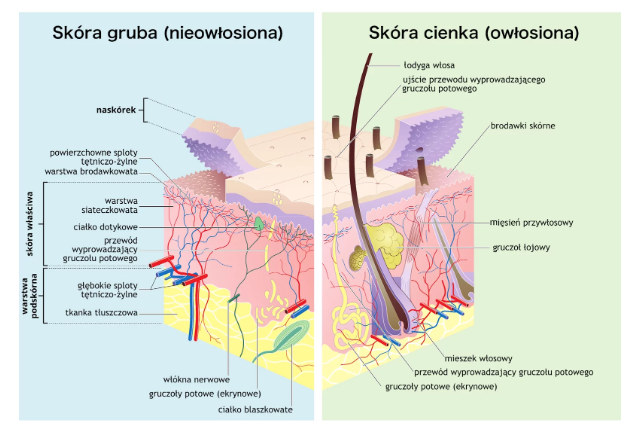
As is already known, our skin has a very complex structure and, as the surface covering our body, is considered one of the largest organs of our body. The condition of our skin often reflects the condition of our entire body. The skin consists of two main layers: outer and inner. The first, visible, hairy outer layer is the epidermis, which forms a barrier between the external environment and the internal body. The second, invisible, hairless layer is called the dermis, which contains important nerve endings, hair follicles, as well as sweat and sebaceous glands. The subcutaneous layer, which is closely connected to the skin, is not considered part of it. It mainly consists of fatty tissue, with only a small percentage being connective tissue. Within the subcutaneous tissue structures are nerve fibers and blood vessels. The main role of the subcutaneous layer is its participation in the process of temperature regulation, which is of great importance for the entire body.

SKIN FUNCTIONS
Human skin performs many physiological functions. Fulfilling an important physiological role, it protects internal organs from harmful environmental, physical, chemical, and microbiological factors. Thanks to the functions of the skin, it allows maintaining balance between the body and the surroundings. The most important and commonly known functions of the skin include the protective function mentioned above, as well as the body's temperature regulation, participation in water and excretory balance, involvement in the synthesis of proteins and certain compounds, and participation in the metabolism of proteins, fats, and carbohydrates. Additionally, it plays an important role in the body's immune response and in the conduction of sensory stimuli. Healthy skin is free from damage related to improper care or harmful environmental effects, tolerates changes in temperature and humidity well, and responds properly to most tested and appropriate care products.
EPIDERMIS
The epidermis is almost entirely made up of living cells called keratinocytes, which undergo the process of keratinization, transforming into dead, dry, and nucleus-free corneocytes as they move upward through the skin.
Layers of the epidermis:
Basal layer (germinal): The layer of stem cells that have almost unlimited ability to divide and supply new cells to the outer surface;
Prickle cell layer: Cells in this layer are not capable of division or growth. The prickle cell layer is thicker in men and becomes thinner with age in both sexes; The basal and prickle cell layers together form the so-called living epidermis, known as the Malpighian layer.
Granular layer: The second stage of cell differentiation. The cell nucleus breaks down. The process of forming a hard keratin fiber takes place;
Horny layer: The final stage of skin differentiation, where young keratinocytes transform into hard and waterproof cells called corneocytes.
SKIN KERATINIZATION
The cause of skin keratinizations, or excessive keratin formation, is the too rapid multiplication of epidermal cells, resulting in scaly patches or thickened areas on the skin. They most often occur in places of increased pressure, such as elbows, knees, and feet, especially the soles. Excessive keratinization of the skin can also be one of the causes of skin imperfections, as too much dead epidermis lining the openings of sebaceous glands can clog pores along with excess sebum. Together with bacteria living on the skin, developing in an oxygen-free environment, they cause painful and unsightly inflammations. Thickened skin often cracks and takes on a yellowish color. This ailment is uncomfortable not only because of its unsightly symptoms but mainly because it can lead to further health problems. Keratinization of the skin can also affect the nail plate, leading to its deformation and thickening. In rare cases, keratinization also causes changes in hair, the cornea of the eye, and teeth. People diagnosed with this condition often also suffer from excessive sweating. Keratinizations on the skin are most often the result of improper care and insufficient shedding of dead epidermis. One of the more difficult cases are so-called hyperkeratoses, which are excessive multiplication of the epidermis, especially on the feet, caused among others by severe skin dryness, tissue aging processes, genetic factors, and allergic reactions.
ELIMINATION OF KERATINIZATIONS AND SKIN THICKENINGS
Skin keratinization usually requires a specialist approach, although in some cases it resolves on its own. Most often, special ointments containing urea and salicylic acid are used on keratinized skin of the hands and soles. The use of emollients, that is, preparations with special fattening properties, is also important. Proper personal hygiene plays a crucial role in the treatment of keratinization. Regarding changes on the feet, wearing comfortable and safe footwear is key. Keratinization does not always respond to treatment without complications. Sometimes treatment is slow and requires a lot of patience.
NL-GHK-CU IN THERAPY ELIMINATING AND PREVENTING SKIN KERATINIZATIONS
Regeneration of keratinized skin depends on the vitality and proliferative potential of stem cells. Skin proliferation begins in the basal layer of keratinocytes, which are attached to the basement membrane. When a cell leaves the basal layer, it undergoes final differentiation. Stem cells have unlimited self-renewal ability, but their proliferative potential decreases with age. The use of the NL-GHK-Cu peptide increases the expression of markers of epidermal stem cells, such as integrins and p63, in basal keratinocytes, in equivalents of the dermis, indicating an increase in stem cells and the proliferative potential of basal keratinocytes. This mode of action of the NL-GHK-Cu peptide allows for determining its potential in combating keratinization and skin thickening, enabling their faster elimination as a supportive therapy for serious keratinization problems of all kinds and as a preventive therapy reducing the risk of their formation.
BIBLIOGRAPHY 1. Pickart L, Vasquez-Soltero JM, Margolina A. GHK Peptide as a Natural Modulator of Multiple Cellular Pathways in Skin Regeneration. Biomed Res Int. 2015;2015:648108. doi:10.1155/2015/648108 2. Perkins C. M., Rose N. J., Weinstein B., Stenkamp R. E., Jensen L. H., Pickart L. The structure of a copper complex of the growth factor glycyl-L-histidyl-L-lysine at resolution. Inorganica Chimica Acta. 1984;82(1):93–99. doi: 10.1016/s0020-1693(00)82544-x. 3. Pickart, L. The human tri-peptide GHK and tissue remodeling. J. Biomater. Sci. Polym. Ed. 2008, 19, 969–988.


NL-Epithalon in preventive treatment allowing the maintenance of proper teeth and in supportive treatment allowing their restoration
NL-Epithalon as a peptide accompanying the reduction of stress response