 English


Abstract: The mentioned regenerative function allows the use of therapy with the peptide BPC-157 in skin diseases. The peptide not only accelerates the healing of existing dermatoses but also alleviates their symptoms and spread.
Keywords: skin; epidermis; dermis; sweat glands; hair; hair follicles; skin disease; dermatoses; impetigo contagiosa; atopic dermatitis; lupus erythematosus; therapy with peptide BPC-157; folliculitis; skin burn; psoriasis; rosacea
List of abbreviations: AZS - Atopic Dermatitis; BPC-157 - Body Protection Compound; VEGF - Vascular Endothelial Growth Factor
Skin
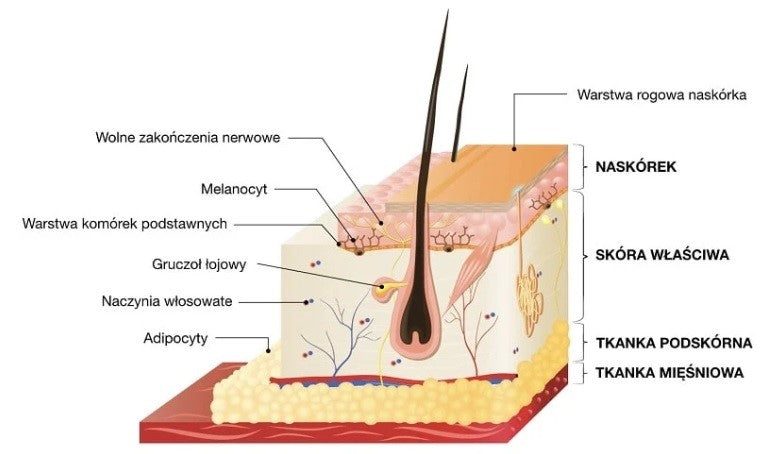
Structure of the skin The skin covering our body is considered one of the largest organs of our body. Its surface area in an adult ranges from 1.6 to 2.0 m², and its thickness from 0.5 to 1.0 mm. It is composed of three basic layers: the epidermis, dermis, and subcutaneous tissue, along with associated sweat and sebaceous glands, hair, nails, blood and lymphatic vessels, and nerve endings. The epidermis, being the outermost layer of the skin, consists of the basal, spinous, granular, clear, and horny layers. The dermis includes the reticular layer, papillary layer, and skin appendages. The network of nerve vessels is located in the dermis, and the skin's blood supply is arterial-venous and lymphatic. Furthermore, the skin surface is covered by a lipid mantle and exfoliated epidermis. An illustrative reminder of the skin's structure is shown in the diagram below.
Functions of the skin
The skin, fulfilling an important physiological role, protects internal organs from harmful environmental, physical, chemical, and microbiological factors. It also allows for maintaining balance between the body and the environment. The most important functions of the skin, which are widely known, include the mentioned protective function as well as the body's thermoregulatory function, participation in water and excretory balance, involvement in the synthesis of proteins and certain compounds, and participation in the metabolism of proteins, lipids, and carbohydrates. Additionally, it plays an important role in the body's immune response and in the conduction of sensory stimuli.
Skin diseases (Dermatoses)
Dermatoses are changes that occur on the skin. They can affect all layers of the skin and even blood vessels, lymphatic vessels, and nerves. The diagnosis of a skin disease involves the appearance of lesions, which are divided into primary and secondary. The first are the result of the development of the disease process, while the second type is a consequence of primary lesions, such as a scar. Dermatoses can be classified into several groups concerning, among others, the etiology of the disease (viral, bacterial, or parasitic), the location of the lesions (hair or nails), or the characteristics of the primary lesions. Skin diseases are not only troublesome for the proper functioning of the body, but their unsightly appearance also lowers our well-being, which is why appropriate therapy to help cure or alleviate symptoms is so important. Some of them are presented illustratively in the table below (Tab.1)
| Background diseases | Disease name | Causes | Symptoms | Treatment |
| Bacterial | Impetigo contagiosa | Strains of staphylococci or streptococci | Blistering wounds, most often around the mouth and nose | ⋅Antibiotic therapy ⋅BPC-157 peptide therapy |
| Fungal | Nail fungus | Infection with pathogenic fungi | Discoloration, thickening, ridging, nail deformation | ⋅Topical treatment ⋅Oral treatment ⋅BPC-157 peptide therapy |
| Allergic | Atopic dermatitis | Genetic, environmental, or immunological | Itching, dryness, and skin discoloration | ⋅Oral treatment including antihistamines ⋅Topical treatment ⋅BPC-157 peptide therapy |
| Diseases connective tissue | Systemic lupus erythematosus | Genetic predispositions | Erythema, ulcers, and skin inflammations | Slowing disease progression through: ⋅Oral therapy ⋅Therapy with the peptide BPC-157 |
Table 1. Selected skin diseases in an overview presentation
Therapy with the peptide BPC-157 for selected dermatoses
1. Folliculitis
As is known, therapy with the BPC-157 peptide is used for regenerative purposes. Hair follicles, which are channels from which hairs grow and are part of the skin structure, form a lipid mantle that protects the skin from damage. When a hair follicle is damaged, microorganisms enter the channels where they multiply. In response, the body develops inflammation. Folliculitis has two main causes: non-infectious and infectious. The first is related to the use of preparations, including corticosteroids, but also as a result of radiation-induced inflammation from excessive sun exposure. The infectious cause is related to bacteria from the streptococci and staphylococci groups, as well as infection caused by Pseudomonas aeruginosa, which is most often due to staying in pools where the water is contaminated. Factors increasing the occurrence of folliculitis include daily activities such as depilation, shaving, or intense skin contact with clothing. Folliculitis appears as a red bump or crust surrounding the hair. Untreated folliculitis or improper hair removal can lead to recurrences and more serious conditions such as boils, so this condition should not be underestimated. Infectious folliculitis can occur during low immunity of our body. In both cases, it is essential to provide the body with substances that eliminate the development of ailments. One method of treatment and prevention is therapy with the BPC-157 peptide.
a. BPC-157 Therapy
Skin disease conditions are accompanied by pain, discomfort, and an unsightly appearance, which is why the ability of the BPC-157 peptide to restore the skin to its original state is highly valued. Thanks to the action of BPC-157, proliferation and differentiation of the basal layer of the epidermis occur, which is significant in the case of folliculitis. Rapid closure of the follicular wound, through the migration and proliferation of epithelial cells, is crucial for restoring the barrier function, which is essential for protecting the body. The peptide's action stimulates the work of macrophages and fibroblasts, leading to faster elimination of inflammation and wound healing by releasing growth factors that promote further migration and proliferation of fibroblasts. There is also the release of inflammatory cytokines to trigger an immune response that will allow the elimination of the infection. Systematic use of the BPC-157 peptide will enable the rapid removal of infection of infectious origin, so that when exposed to factors favoring its development, the risk of folliculitis will be minimal. Using BPC-157 in the event of folliculitis will help alleviate symptoms, speed up healing, and stop the spread of inflammation.
2. Atopic dermatitis
Atopic dermatitis (AD) is a chronic inflammatory skin disease. The cause of AD is not clearly defined or known, but the most probable and common theory concerns genetic aspects. Other causes include improper hygiene, allergens, or immune system abnormalities. Symptoms accompanying atopic dermatitis include itching, swelling, eczema, dryness, redness of the skin, and the formation of lichen. Over time, the skin may become scaly and thickened due to its increased sensitivity, for example, from continuous scratching of the itchy area. Appropriate treatment is therefore necessary to alleviate the symptoms of the disease so that it does not spread by forming larger lesions on the skin and without transferring them to adjacent areas.
a. BPC-157 Therapy
Considering the pathomechanism of AD, there is a disturbance in the balance between TH1 and TH2 lymphocytes, between which a balance should be maintained to ensure the proper structure of the skin without pathological disorders. BPC-157 therapy in the case of atopic dermatitis allows for therapeutic management targeting T cell pathways by blocking specific molecules involved in itching and inflammation. As mentioned, in the case of folliculitis, the peptide's action stimulates macrophage activity. This is important during atopic dermatitis therapy because their stimulation increases the production of B, T, and NK lymphocytes, which leads to the restoration of balance between T lymphocytes and consequently alleviates the symptoms of atopic dermatitis, including excessive keratinization and lichenification resulting from intense itching. In the treatment of AD, corticosteroids are most commonly used, which, when used for a longer time, are characterized by a wide range of side effects, which is why it is so important to apply alternative therapy that has the desired effect while eliminating dangerous side effects. BPC-157, as a fully safe product even with prolonged use, may become a new mediator in the treatment of atopic dermatitis.
3. The effect of BPC-157 therapy on alleviating symptoms of atopic dermatitis
Skin burns
Burns in the case of skin are characterized by damage to varying degrees. Specific degrees of burns are distinguished: the first degree involves only the epidermis on the surface of the body, the second degree includes all layers of the epidermis and part of the dermis beneath the epidermis, and the third degree involves all layers of the skin and epidermis reaching the subcutaneous connective tissue. The fourth degree concerns deeper tissues and necrosis. Depending on the surface area of the burn, burns are classified as mild, moderate, or severe. Burn treatment is sometimes tedious and painful, so appropriate treatment to alleviate symptoms and accelerate healing is important.
a. BPC-157 Therapy
During therapy with the peptide BPC-157, there is an increase in the production of collagen fibers. Studies have also shown a reduced number of inflammatory cells. The peptide promotes the action of vascular endothelial growth factor VEGF, causing the formation of blood vessels which supports skin regeneration processes. In the action profile of BPC-157, in the case of burns, less extensive necrosis and the formation of skin reticulin were also observed. Thanks to these processes, burns heal faster and more effectively, and the scars resulting from them are smaller and smoother.
4. Skin necrosis
Skin necrosis appears at the site of an existing wound, most often one caused by crushing, frostbite, or burns. The cause of skin necrosis is tissue hypoxia or ischemia as well as bacterial infection. In the case of skin necrosis, two types are distinguished: dry gangrene, which is not caused by bacteria, and wet gangrene, which develops due to bacterial proliferation near the wound. Symptoms associated with necrosis include pain, swelling, and redness, followed by the appearance of blisters filled with pus and gas. Additionally, general symptoms affecting the whole body occur with necrosis, such as malaise, increased blood pressure, or body temperature. Treatment of necrosis involves the administration of antibiotics, oxygen therapy, or removal of dead tissue. Modern methods indicate the use of the peptide BPC-157 in the therapy of skin necrosis treatment.
a. BPC-157 Therapy
BPC-157, acting regeneratively, causes a reduction in ulcers or prevents their formation within the wound area. The peptide's action results in a significantly reduced necrotic area and a shallower wound. By activating transforming growth factor (TGF)-β1, the BPC-157 peptide leads to an increased number of capillaries without an increase in their diameter, advanced formation of skin reticulin and collagen fibers, and an increased number of preserved hair follicles. The entirety of these processes indicates the effectiveness of BPC-157 therapy in skin necrosis. 5.Psoriasis Psoriasis is a chronic and recurring skin disease that is not contagious. The changes occurring on the skin are visible and usually appear in areas such as the elbows, knees, or scalp. The cause of the disease is not clear, but genetic factors related to the polymorphism of the HLA-Cw6 gene are most often indicated. Psoriasis may also have an immunological basis, where Langerhans cells, thymus-dependent lymphocytes, and T lymphocytes play an important role. The symptoms occurring during the disease primarily include scaly lesions of a reddish-brown color. The skin after scraping off the characteristic scales is smooth and shiny. Another possible symptom is skin sensitivity to scratches, where even the smallest scratch causes blood vessels to rupture, resulting in bleeding at that site. The method of treating psoriasis depends on the severity of the disease and includes topical or systemic treatment.
a. BPC-157 Therapy
The BPC-157 peptide is characterized by its ability to inhibit the increased expression of β-defensins, LL-37, RNase 7, psoriasin, and lysozyme, which may make it one of the main factors responsible for reduced susceptibility to skin infections in patients with psoriasis. The peptide itself will not eliminate the disease, but it will significantly improve quality of life during its occurrence and minimize its symptoms to a minimum. The course of the disease is also important. Skin changes associated with psoriasis occur sequentially, in strictly defined phases. During BPC-157 therapy, some of these phases may be inhibited, causing the spread of the disease to be halted and the possibility of more severe symptoms to arise.
6.Rosacea
Rosacea is a chronic disease affecting only the facial area. It is worth mentioning that its occurrence most often begins after the age of 30, even when previous lack of symptoms did not indicate it. The causes of rosacea are genetic predispositions as well as hormonal and vascular backgrounds. Additionally, exogenous, infectious factors occurring locally (including infections), dietary factors (improper diet), psychogenic factors (stress), and atmospheric factors (sun, humidity, cold) may participate in the development of rosacea. Less frequently, its cause is the consequence of using antibiotics or statins. Symptoms usually start with changes on the skin of the nose, then spread to the cheeks, chin, forehead, as well as the neck and décolletage. Treatment of rosacea requires a lifestyle change, and antibiotics are used in both topical and systemic treatment. As a precursor in the treatment of rosacea, the BPC-157 peptide is used.
a. BPC-157 Therapy
In the skin disease known as rosacea, changes occur characterized by high expression of cathelicidin. Through the action of the BPC-157 peptide, the enzyme KLK5, which occurs in high concentrations within skin lesions, begins to work. In skin affected by rosacea, the KLK5 enzyme is present throughout the epidermis, and the action of BPC-157 causes its concentration to decrease, resulting in its presence only in the upper layers of the epidermis (granular and horny layers). This process leads to a reduction in symptoms, their visibility, and the inhibition of the spread of rosacea to adjacent areas of the facial skin.
Summary
Healthy skin, its continuity and aesthetic appearance guarantee comfort of life and proper functioning of our body. Disease changes called dermatoses can affect both small changes and areas of the skin as well as serious and extensive changes. In both cases, the use of appropriate therapeutic treatment is important in alleviating symptoms and stopping the spread of the disease. Therapy with the BPC-157 peptide is effective and safe in many cases concerning dermatoses. Prophylactic use of the peptide, even in large doses, does not cause adverse effects but rather therapeutic ones.
Bibliography
1.Takeo.M, Lee.W, Ito.M, Wound Healing and Skin Regeneration. 2015; DOI:10.1101/cshperspect.a023267
2.Wolk.K., Kunz.S, Witte.E. Friedrich.M, Asadullah.K, Sabat,R, IL-22 increases the innate immunity of tissues. 2004; 21: 241-254; DOI: 10.1016/j.immuni.2004.07.007
3.Rieg.S, Steffen.H, Seeber.S, Humeny.A, Kalbacher.H., Dietz.K, Deficiency of dermcidin-derived antimicrobial peptides in sweat of patients with atopic dermatitis correlates with an impaired innate defense of human skin in vivo. 2005; 174; 8003-8010; DOI:10.4049/jimmunol.174.12.8003
4.Seiwertha.S, Mikusa.D, Sikirica.P, Perovica.D, Kokica.N, Pentadecapeptide BPC 157 cream improves burn-wound healing and attenuates burn-gastric lesions in mice. 2001 DOI:10.1016/s0305-4179(01)00055-9
5.Bilic.M, Bumber.Z, Blagaic.A, Sikiric.P, The stable gastric pentadecapeptide BPC 157, given locally, improves CO2 laser healing in mice. 2004; DOI:10.1016/j.burns.2004.10.013
6.Sørensen.E, Cowland.J, Ganz.T, Borregaard.N, Wound healing and expression of antimicrobial peptides/polypeptides in human keratinocytes, a consequence of common growth factors. 2003; 170, 5583-5589; DOI:10.4049/jimmunol.170.11.5583
7.Christophers.E, Henseler.T, Contrasting disease patterns in psoriasis and atopic dermatitis. 2000; 48-51; 10.1007/BF00585919


BPC-157 therapy in the cardiovascular system. The heart-protecting effect of the peptide and its use in cases of metabolic diseases.
BPC-157 in the urinary and reproductive system. Peptide therapy in kidney diseases.